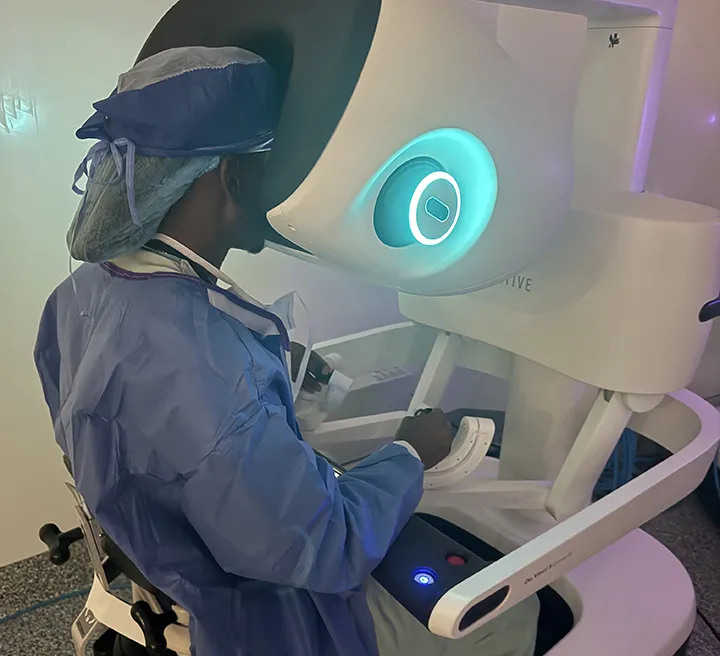
Robotic Surgery: From Video Games to the OR
Level Up Your Health: How Your PS5 Skills Relate to Modern Robotic Surgery
Bios: Stephen L. Noble, MD, FACS, is a Thoracic Surgeon and the Medical Director of the Lung Nodule Program at Chesapeake Regional Surgical Specialists. With extensive experience in cardiothoracic surgery, including establishing robotic thoracic surgery programs during his military service, Dr. Noble is a leader in applying cutting-edge technology to patient care.
Key Takeaways:
- The da Vinci 5 surgical system at Chesapeake Regional Healthcare translates a surgeon's hand movements into micro-movements, using technology similar to a high-end video game console.
- This minimally invasive technology features ultra-realistic 3DHD visuals and Force Feedback, allowing surgeons to feel tissue resistance through the controls, much like haptic feedback in a PS5 controller.
- Your passion for gaming develops valuable skills like hand-eye coordination and problem-solving, which are directly applicable to careers in advanced medical fields like robotic surgery.
- Implement this insight by taking advanced science and tech classes seriously, knowing that your digital fluency is a valuable asset for the future of health care.
Your Gaming Passion Could Shape the Future of Medicine
Have you ever wondered if the hours you've spent mastering a video game could translate into a career saving lives? At Chesapeake Regional Healthcare, that idea is no longer a fantasy. For cardiothoracic surgeon Dr. Stephen Noble, the connection is crystal clear. He describes our new da Vinci 5 surgical system as the "PS5 of robotic surgery," complete with haptic feedback that feels like the hit stick in a game of Madden. This isn't just a clever analogy; it's the new reality of minimally invasive care. The same focus, precision and digital intuition honed in virtual worlds are now essential skills in the operating room. At Chesapeake Regional, we're not just acquiring the most advanced technology—we're empowering surgeons who grew up with this technology in their hands. This fusion of skill and innovation means better, more precise care for our community and opens up a new world of possibilities for what a career in medicine can look like.
Explore the Ultimate "Next-Gen Console" for Surgery
The da Vinci 5 is the newest and most advanced robotic-assisted surgical platform, and Chesapeake Regional is the first in Hampton Roads to put it into practice. Forget old sci-fi tropes of robots operating alone. With the da Vinci system, a highly trained surgeon is 100% in control, using a console to guide tiny, wristed instruments inside a patient's body. Think of it as the most sophisticated controller ever built. The system translates the surgeon's natural hand movements into smaller, more precise actions, eliminating tremors and allowing for a level of detail impossible with the human hand alone.
What makes the da Vinci 5 a true game-changer are its immersive features. Surgeons see the operating field in breathtaking, high-definition 3D with truer colors and higher resolution than ever before. It's an unprecedented view that enhances their ability to navigate complex anatomy. And for the first time, this system includes Force Feedback technology. This allows the surgeon to actually feel the pressure and resistance of tissue through the controls. It provides a tactile sense of touch that was previously missing from robotic surgery, making delicate procedures even safer and more intuitive. With more than 10,000 times the computing power of the previous model, the da Vinci 5 isn't just a tool; it's a smart, responsive partner in providing minimally invasive care for urology, gynecology, thoracic and general surgeries.
Meet the Surgeon Who Leveled Up From Nintendo to the Operating Room
When you picture a thoracic surgeon, you might not immediately think of a lifelong gamer who started with a Commodore and worked his way through every Nintendo and PlayStation console. But that's exactly the story of Dr. Stephen Noble. "What I do now as a robotic surgeon is pretty much like playing a video game," he says, highlighting how the intuitive controls and feedback of the da Vinci 5 feel like a natural extension of a skill he's been developing since he was five years old.
Dr. Noble's journey is a powerful testament to where passion and dedication can lead. After graduating from med school, he served as a Staff Cardiothoracic Surgeon in the U.S. Navy, providing critical care to service members. His deployment to a combat hospital in Afghanistan saw him perform life-saving surgery on over 80 critically injured casualties, contributing to a 99 percent patient survival rate. Throughout his career, both in the military and at leading medical centers, Dr. Noble has been a pioneer, establishing robotic thoracic surgery programs and performing landmark procedures. His work is driven by a mission to use technology to diagnose and treat diseases like lung cancer at the earliest possible stage. Now, he brings that world-class expertise right here to our community at Chesapeake Regional.
Translate Your Skills From the Screen to the Operating Room
Dr. Noble has a direct message for anyone passionate about gaming: "Continue playing video games, but do well in school, especially with those advanced classes. You can work in medicine and be a robotic surgeon...it feels like playing a video game."
This is more than just encouragement; it's an invitation to see your interests as a launchpad for an impactful future. The skills required to excel in complex games—unwavering focus, rapid problem-solving, precise hand-eye coordination and spatial reasoning—are the exact same cognitive abilities needed to manipulate a surgical robot. The ability to process complex visual information on a screen and translate it into fine motor action is a form of digital literacy that previous generations never had. As medicine becomes increasingly integrated with technology, people like you who are native to the digital world are uniquely positioned to lead the way. By pairing your passion with a strong foundation in science and math, you can build a career at the forefront of medical innovation.
The Future of Health Care Is in Your Hands
The arrival of the da Vinci 5 at Chesapeake Regional is more than a technology upgrade; it represents a fundamental shift in how we approach surgery. It's a move toward procedures that are more precise, less invasive and produce better outcomes for patients. This technology empowers our surgeons to perform at the peak of their abilities, blending human expertise with robotic precision. For our community, this means access to world-class care, close to home.
For the next generation, this story carries an even bigger message. The lines between technology, recreation and career are blurring. The skills you are building today in unexpected places have profound real-world value. Surgeons like Dr. Noble prove that a passion for gaming and a passion for healing can be one and the same. As you think about your future, remember that the tools shaping our world are becoming more intuitive and integrated every day. Chesapeake Regional is committed to staying at the forefront of this evolution, ensuring that the best technology is in the hands of the most skilled and dedicated professionals. The future of health care is bright, and it's being built by people who know how to win the game.
To learn more about minimally invasive surgery at Chesapeake Regional, contact our team.
FAQ:
What is the da Vinci 5 robotic surgery system?
The da Vinci 5 is the most advanced robotic-assisted surgical platform from Intuitive. It allows a surgeon to operate using a console that translates their hand movements into the precise, micro-movements of tiny instruments inside a patient's body for minimally invasive procedures.
Is the robot performing the surgery by itself?
No, absolutely not. The surgeon is always 100% in control. The da Vinci 5 is a tool that enhances the surgeon's skill by providing magnified 3DHD vision, greater precision and tremor-free movement. It cannot move or make any decisions on its own.
What are the benefits of minimally invasive robotic surgery?
Compared to traditional surgery, minimally invasive procedures with systems like the da Vinci 5 typically involve smaller incisions. This can lead to benefits for patients such as reduced pain, less blood loss, a lower risk of infection and a faster recovery.
What kinds of surgeries use the da Vinci 5 at Chesapeake Regional?
The da Vinci 5 is a versatile platform used across several specialties. At Chesapeake Regional Healthcare, it can be used for thoracic (chest), urology, gynecology and general surgeries such as hernias.
How does playing video games really help a surgeon?
As Dr. Stephen Noble explains, playing video games develops key skills like intense focus, excellent hand-eye coordination, quick problem-solving and fine motor control. These are the same skills needed to expertly control the sophisticated interface of a surgical robot.
Can I become a robotic surgeon one day?
Yes. If you are interested in a career in medicine and have an aptitude for technology, robotic surgery could be a great fit. Dr. Noble advises focusing on advanced science and math classes in school to build a strong foundation for medical training.
What kind of training does a robotic surgeon like Dr. Noble have?
Robotic surgeons are highly trained medical doctors who first complete medical school and then a multi-year residency in a surgical specialty. Afterward, they undergo extensive, specialized training and certification on the da Vinci surgical system to master its use for specific procedures.